The first person to reject me on my wedding day was not my fiancé. It was my father.
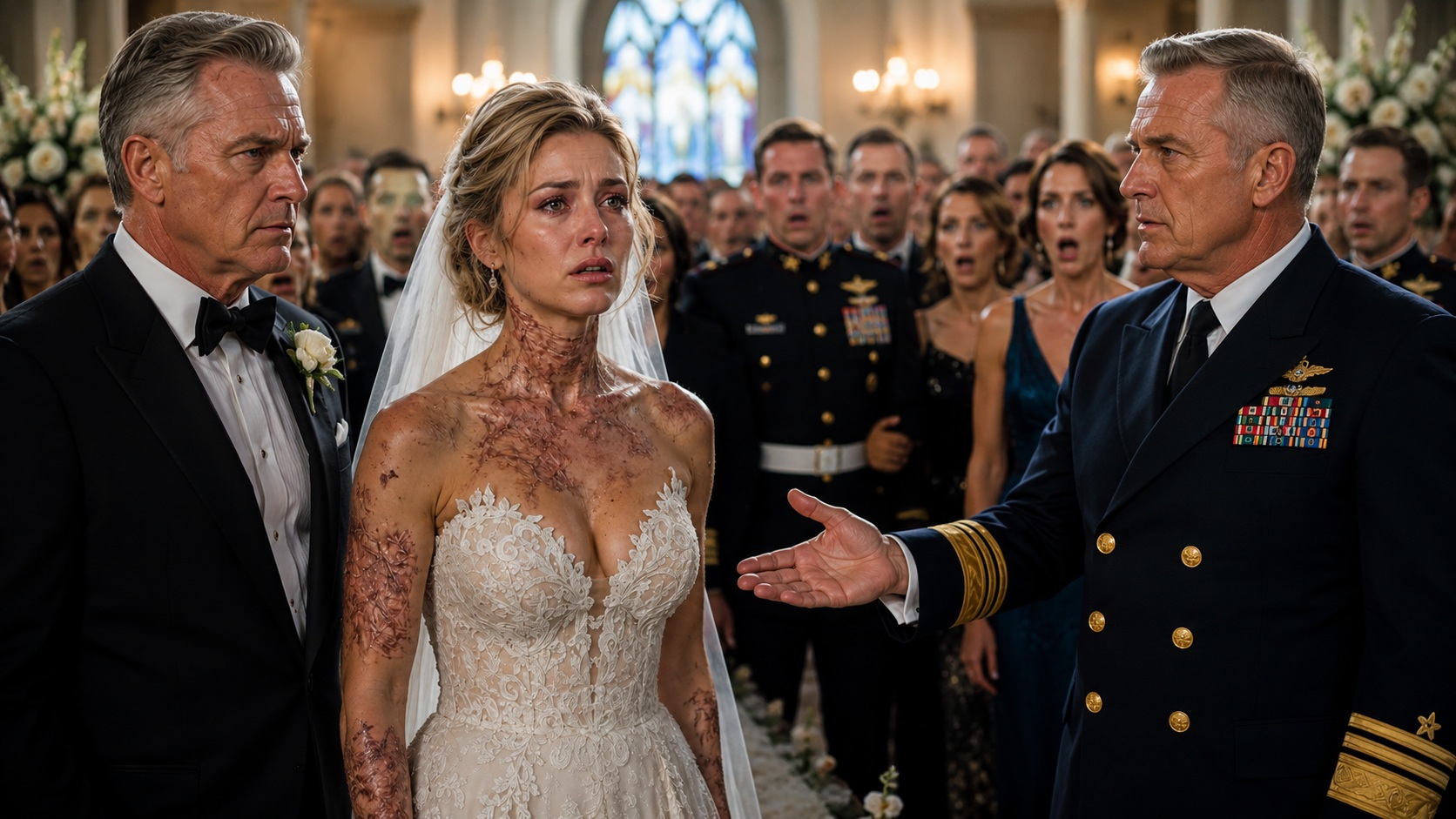
He stood beneath an arch of white roses at the chapel entrance, his eyes fixed on the pale scars crossing my neck and shoulder, exposed where my gown dipped below the collarbone. His grip on my arm loosened, as though my skin had scalded him.
“I will not walk a damaged bride down the aisle,” he whispered.
Only minutes earlier, he had smiled for photographers, telling reporters that courage ran in the family. Now he could barely look at me.
The string quartet faltered mid-note. Heads turned. My stepmother, Celeste, hid a smile behind a jeweled hand. My half-brother leaned toward a senator’s son and murmured, “Told you she came back broken.”
At the altar, Daniel’s jaw tightened, but he didn’t move. He knew better than to fight my battles for me.
I looked at my father. “You invited three hundred people to watch you say that?”
He adjusted his tuxedo jacket, unbothered. “I invited them to witness a respectable marriage. Those scars invite questions.”
“Good. They should.”
For twenty years, Victor Hale had built an empire selling navigation systems to the military. He loved medals, uniforms, ceremony — everything the military stood for, except the daughter who had actually earned the right to wear its insignia.
To the public, I was Major Evelyn Hale, a logistics officer recently returned from overseas, wounded in an accident. My father had made sure that version ran in every society page.
The truth was classified.
Before he could step back again, Admiral Marcus Reed rose from the front pew. His expression turned to stone. He crossed the aisle and snapped to attention in front of me.
“General Hale,” he said, his voice carrying to the rafters, “it would be the greatest honor of my career to walk you down this aisle — the woman who saved my entire carrier group.”
The chapel went silent, then erupted in gasps.
My father’s face drained white. Celeste breathed, “General?”
I held Victor’s stare. “You should have asked where the scars came from.”
That was when the chapel doors opened behind us.
Four military investigators stepped through in dark dress uniforms. Between them walked a federal prosecutor, a sealed black case in her hands.
My father’s expression didn’t collapse because he finally understood who I was.
It collapsed because he recognized that case.
Part 2 — The Sealed Case
The prosecutor’s heels struck the marble floor in a rhythm that seemed to match my own pulse. Her name was Adrienne Cole, and I had spoken to her exactly once before, three weeks earlier, in a windowless room at the Pentagon.
She stopped a few feet from my father. “Victor Hale, I need a moment of your time.”
He straightened his jacket, trying to reclaim the composure that had photographed so well an hour ago. “This is my daughter’s wedding. Whatever this is, it can wait.”
“It can’t,” Cole said. “It’s been waiting for eleven years.”
Guests who had been murmuring now sat in absolute silence. Even the string quartet had stopped pretending to tune their instruments.
I turned to Marcus Reed, still standing at attention beside me. “Admiral, you knew they were coming.”
“I requested it,” he said quietly. “You saved my men. You deserved to have the truth walk in with you, whether your father wanted it here or not.”
Daniel finally moved, stepping down from the altar to stand at my side. He didn’t touch me. He didn’t need to. His presence was enough to say he wasn’t going anywhere.
One of the investigators, a broad shouldered man with silver hair, addressed my father directly. “Mr. Hale, eleven years ago your company supplied faulty navigation modules to a carrier group in the Pacific. Those modules were certified safe despite three failed internal tests. When the systems failed during a live operation, your daughter’s unit took the casualties meant for four hundred sailors.”
Celeste’s jeweled hand fell from her mouth.
My father’s voice cracked when he tried to speak. “That’s an old case. It was closed. Ruled equipment malfunction, nothing more.”
“It was closed,” Cole said, “because someone buried the internal test results. We found them last month, in a storage unit registered to your name.”
The black case in her hands seemed heavier now, though nothing about it had changed.
My half brother had gone pale beside the senator’s son, who was now recording everything on his phone.
I looked at my father, the man who had built his fortune on the uniforms other people bled for. “You asked where my scars came from. Now you know. And so does everyone else in this room.”
He didn’t answer. For the first time in my life, Victor Hale had nothing to say.
Part 3 — Before the Uniform
To understand why my father’s silence mattered so much, you have to understand who Victor Hale raised me to be, and who I became instead.
I was twelve when he first took me to a shipyard, not to teach me anything about the sea, but to show me the gleaming hull of a destroyer his company had just outfitted with new radar systems. “This is legacy,” he told me, resting his hand on the metal. “Not medals. Contracts.”
He wanted a daughter who understood spreadsheets, not sacrifice. When I told him at seventeen that I wanted to attend the Naval Academy, he laughed, certain it was a phase.
It wasn’t.
I graduated near the top of my class, and my father attended the ceremony wearing an expression like he’d swallowed something bitter. He gave interviews afterward calling it “a formative experience,” as if I’d finished a gap year abroad rather than earned a commission.
Ten years later, I commanded a unit responsible for coordinating logistics and defense systems for a carrier group in the Pacific. It was quiet work, technical work, the kind that rarely made headlines.
Until the night the navigation systems failed.
We were running defensive drills when three ships lost coordinated tracking simultaneously. What should have been a controlled exercise turned into chaos within minutes. I made the call that kept two vessels from colliding in open water, a decision that meant placing my own ship between them.
The fire that followed left scars across my neck and shoulder that no formal dress uniform could fully hide.
Four hundred sailors went home to their families because of choices made in about ninety seconds. I spent the following year in and out of hospitals, then months more in classified debriefings, because the investigation into why the systems failed kept hitting walls that powerful people had built.
I didn’t know then that one of those walls belonged to my father.
When I was finally promoted to General, quietly, without press releases, because most of what I’d done remained classified, my father hosted a party and told guests I had “recovered from an accident overseas.” He never asked what kind of accident. He never asked why promotions kept finding a daughter he introduced as fragile.
I let him believe the story he preferred, because I was tired of being cross examined by my own family. I didn’t know that his comfort with that story wasn’t ignorance.
It was self preservation.
Part 4 — What Victor Hale Sold
Adrienne Cole opened the black case on a small table one of the ushers dragged forward, as though the chapel had transformed into a courtroom without anyone agreeing to it.
Inside were three folders, each stamped with a date eleven years old.
“These are the internal test results your engineering team filed,” Cole said, turning the first folder so my father could see it without touching it. “Failure rate under combat conditions: unacceptable. Recommendation: halt production pending redesign.”
My father said nothing.
“This is the report that actually reached the Navy,” she continued, lifting the second folder. “Failure rate: negligible. Recommendation: proceed with deployment.”
Someone in the pews whispered a curse word and didn’t bother to apologize for it.
“Two different conclusions,” Cole said, “written eight days apart, by the same engineering team. Someone told them to change their numbers.”
The silver haired investigator stepped forward. “We traced the email authorizing the revision. It came from your private account, Mr. Hale.”
My father’s hands had begun to tremble, though his voice remained steady, the same practiced steadiness he used in every interview he’d ever given. “Contracts like that involve dozens of signatures. You can’t possibly pin this on one email.”
“We can,” Cole said, “because the email specifically instructed the team to remove references to thermal failure in high stress combat maneuvers. The exact failure that caused the fire aboard my client’s ship.”
The word client hung strangely in the air, a reminder that somewhere beneath the wedding dress and the roses, I was still the woman at the center of a federal case.
I finally spoke. “You knew. Before I ever stepped foot on that ship, you knew the systems could fail.”
“I knew there were concerns,” my father said. “Every product has concerns. You cannot run a defense company by killing every project that gets a bad internal memo.”
“You ran this one anyway. Sailors under my command are alive today because I made a decision in ninety seconds that your company should have made eleven years ago in a boardroom.”
Celeste had gone very quiet beside him, no longer covering smiles, no longer whispering to anyone. My half brother wouldn’t meet my eyes.
“Victor Hale,” the investigator said, “we’re going to need you to come with us.”
My father looked at me, and for one unguarded moment, I saw something that wasn’t shame or fear. It was calculation, the same expression he wore during every negotiation I’d ever watched him run. He was already looking for the exit.
“Not here,” he said. “Not at my daughter’s wedding.”
“You made it about the wedding,” I said, “the moment you called me damaged in front of three hundred people.”
Part 5 — The Family That Watched Her Bleed
The investigators didn’t move yet. They seemed to understand, or perhaps Cole had instructed them, that some part of this needed to happen in front of everyone before it happened in a courtroom.
Celeste rose from her seat, smoothing her dress as though composure were a fabric she could simply straighten. “Evelyn, surely this doesn’t need to happen right now. Whatever business issues Victor has, they have nothing to do with you.”
“They have everything to do with me,” I said. “I have scars because of his business issues.”
My half brother, Julian, finally looked up. He was twenty-four and had spent most of his adult life being groomed to inherit exactly what my father had built. “I didn’t know anything about the reports,” he said quickly, as if the accusation had already reached him. “I was barely out of college when that happened.”
“Nobody’s accusing you of writing the email, Julian,” I said. “But you called me broken an hour ago. You knew enough to have an opinion about who I was, just not enough to ask why.”
He had no answer for that.
Celeste’s hand found my father’s arm, though her eyes were calculating something far more practical than comfort. “Victor, the company. The board will need a statement before this reaches the press.”
“The press already has it,” Cole said. “Federal indictments aren’t discreet, Mrs. Hale.”
My father flinched at his own name being paired with the word indictment.
I thought of every dinner where he’d introduced me as fragile, every society column that called my career an accident, every time Celeste had smiled at some joke about my scars while sipping champagne beside my father. None of them had asked where the scars came from because the answer was inconvenient for the family narrative they preferred.
Admiral Reed spoke, quiet but firm enough to carry. “For what it’s worth, General, the men and women who served under you never once called you broken. They call you the reason they came home.”
Daniel took my hand then, the first time he’d touched me since I stepped through the chapel doors that morning. “Whatever happens next,” he said, “it happens with you standing exactly as you are. Nothing about you needs fixing.”
My father looked at the two of us, then at the investigators waiting patiently by the doors, then at Celeste, who had already begun calculating how to spin this for people who mattered more to her than I ever had.
“I built everything for this family,” he said, quiet now, almost pleading.
“You built it on my back,” I said, “and you were ashamed of the scars it left.”
Part 6 — The Vows She Chose
The investigators finally stepped forward. My father didn’t resist when they flanked him, though his eyes stayed fixed on me, searching for something, forgiveness, maybe, or simply an audience that still believed his version of events.
He wouldn’t find it here.
“Victor Hale,” the silver haired investigator said, “you have the right to remain silent.”
Celeste’s composure cracked at last. She grabbed for her clutch and her phone in the same motion, already dialing someone, a lawyer, a publicist, someone whose job was managing collapses like this one.
Julian sat frozen in the front pew, watching the father he’d modeled his entire future on being led past rows of stunned guests.
As they reached the chapel doors, my father turned back one final time. “Evelyn.”
I didn’t move toward him.
“I didn’t know how to be proud of something I couldn’t control,” he said. “You were never supposed to be stronger than me.”
“I was never trying to be stronger than you,” I said. “I was trying to survive something your company caused. You made it a competition. I just made it out alive.”
He had no answer for that either. The doors closed behind him, and for a moment the chapel held its breath, three hundred guests unsure whether a wedding could still happen after something like this.
Admiral Reed broke the silence. He turned to me and offered his arm, the gesture he’d already claimed once before, though this time it felt final rather than symbolic. “General Hale, may I still have the honor?”
I looked at Daniel, waiting at the altar exactly where he’d stayed through all of it, unmoved, unashamed, uninterested in a version of me that needed hiding.
“Yes,” I said. “You may.”
The quartet, uncertain until now, found their notes again. I walked down the aisle on the arm of a man I had saved, past a stepmother already fleeing scandal, past a brother rewriting his understanding of our family in real time, toward a man who had never once flinched at my scars.
When Daniel took my hand at the altar, he didn’t lower his eyes to the marks along my collarbone. He looked only at my face.
“You once told me you didn’t want rescuing,” he said quietly, just for me. “I’m not here to rescue you. I’m here because you already saved yourself, more than once. I just want to be the one standing beside you when you do it again.”
I had walked into that chapel as someone’s damaged daughter.
I walked out of it as exactly who I always was: a woman who survived what powerful men tried to bury, and who refused to let shame decide whose arm she walked on.