Chapter List
Part 1: “The Smell of Someone Else’s Thanksgiving”
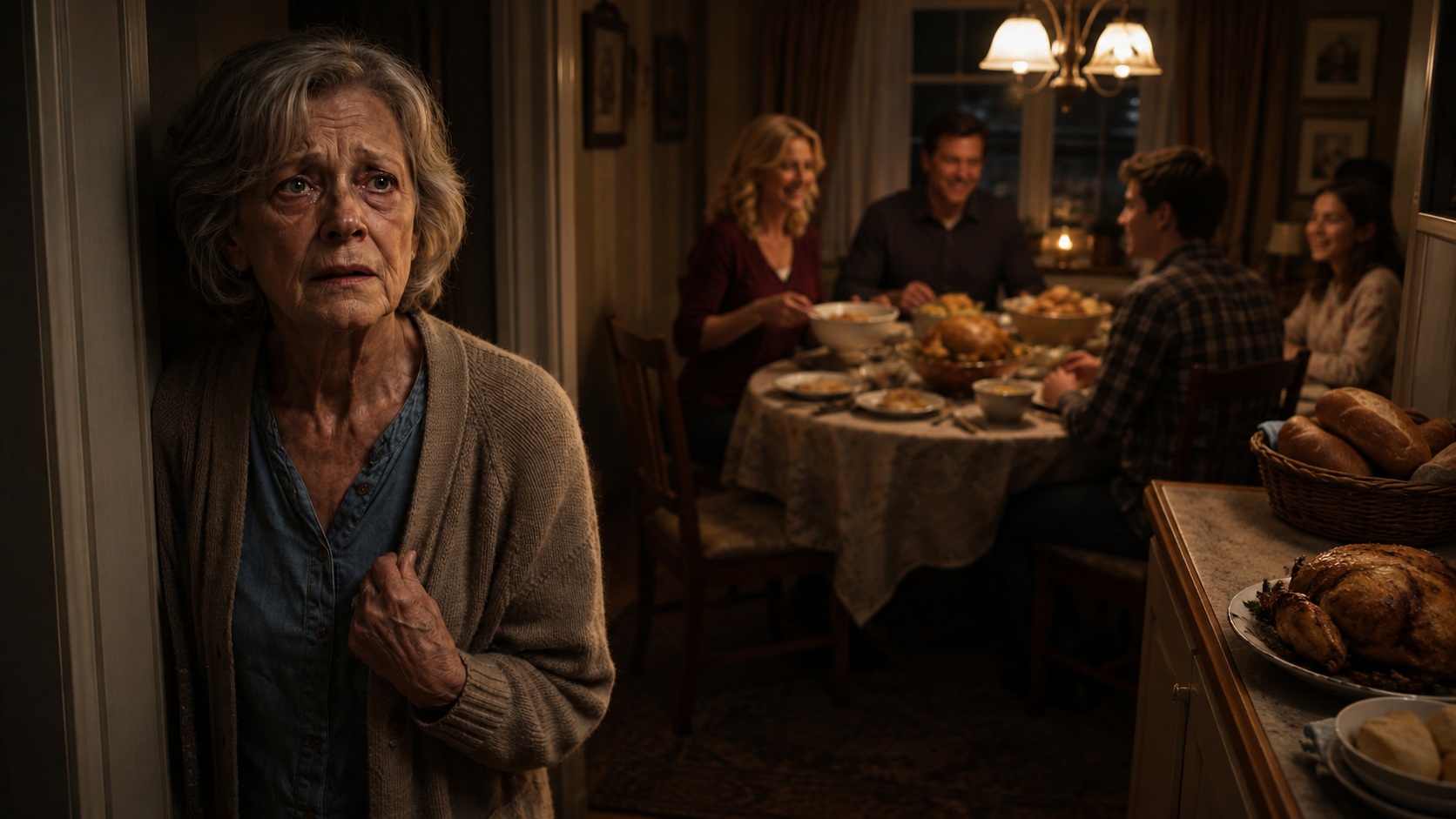
I could smell roast chicken and fresh bread from downstairs, but my plate never came.
By Thanksgiving morning, I already knew I wouldn’t be sitting at the table with the rest of my family.
The smell started early. Roast chicken, butter melting into fresh bread, yams with brown sugar. My daughter, Melissa, had always known how to make a house feel warm when she wanted to. From upstairs, in the small guest room she’d slowly turned into my room, I could hear cabinets opening, football commentators laughing, my grandchildren running down the hallway in socks.
I sat on the edge of the bed, waiting for someone to call me down.
No one did.
At seventy-four, I no longer moved as quickly as I used to. After my fall the year before, Melissa insisted I live with her. “It’s for your safety, Mom,” she’d said. I believed her. I sold my little condo, gave her most of the money to help with expenses, and told myself this was what families did for one another. But over the months, safety had begun to look a lot like control.
She kept my phone downstairs “so I wouldn’t lose it.” She handled my medication “so I wouldn’t forget it.” She corrected me in front of the children, rolled her eyes at simple questions, reminded me almost daily that I was lucky she’d taken me in when “most people would’ve put me somewhere.”
By late afternoon, the pain in my stomach was sharp enough to make me lightheaded. I went downstairs slowly and found Melissa in the kitchen, arranging serving bowls like a magazine shoot.
“Melissa,” I said, keeping my voice steady, “I haven’t eaten since yesterday.”
She didn’t look up right away. When she finally turned, her face was flat, annoyed.
“You’re always hungry,” she snapped. “You’re like a burden that never stops needing.”
My grandson stood frozen in the doorway. My granddaughter looked at the floor.
“I’m not asking for much,” I whispered.
Melissa stepped closer, lowered her voice. “Then stop acting like a victim in my house.”
The doorbell rang. Guests were arriving. She smiled instantly and walked to the door like nothing had happened.
I realized the hunger wasn’t the worst part. It was the performance.
That night, as the family sat down to eat, I heard Melissa telling her husband in the dining room, “Don’t give her anything yet. She needs to learn she can’t manipulate everyone with that sad face.”
I stood in the hallway, unseen, hands shaking.
Then I heard something worse.
Her husband asked quietly, “How long are you planning to keep doing this?”
Melissa answered, “Until she signs the rest of it over.”
Part 2: “The Locked Drawer”
The house finally went quiet after midnight. Plates scraped clean, laughter faded, the guests gone home with foil-wrapped leftovers I never got to taste.
I lay awake listening to Melissa move through the house, locking doors, turning off lights, checking on the kids. When her footsteps disappeared into her bedroom, I waited a long time before I let myself move.
My legs ached from sitting in that room all day, but hunger has a way of making a person brave in strange, quiet ways. I told myself I only wanted a piece of bread. Just enough to stop the shaking in my hands.
The kitchen was dark except for the porch light spilling through the window. I found half a loaf on the counter and ate standing up, too afraid to sit, too afraid to make a sound. It was while I was there, waiting for my heart to settle, that I noticed the door to Melissa’s home office was open, just a crack.
I do not know what made me walk toward it. Maybe it was her husband’s question still echoing in my head. Until she signs the rest of it over.
The desk was covered in papers. Bills, printed emails, a folder with my name on it. My hands were trembling for a different reason now. Inside the folder were documents I did not remember signing, some blank lines still waiting for my signature, and others already filled in with my name in a shape that did not look quite like my handwriting.
Power of attorney. Property transfer. My condo, the one I thought I had simply sold to help the family, listed with a sale price far higher than what Melissa had told me. The money never came to me. I searched for where it might have gone and found only a note in the corner of one page. Reserve account, pending signature.
I heard a floorboard creak somewhere above me and froze, folder still in my hands.
It was not Melissa’s footsteps. It was lighter, quicker. A child’s steps, or someone trying to be quiet like a child would.
I turned toward the hallway just as a shadow slipped back around the corner. Someone had been watching me.
In the pocket of an old coat hanging by the office door, the coat I remembered wearing the day I moved in, I found a business card I did not recognize. A lawyer’s name, an address across town, and on the back, in ink that was unmistakably my own handwriting, three words I had apparently written to myself and forgotten.
Call him first.
Part 3: “The Ally in the Kitchen”
I did not sleep that night. I sat with the business card in my lap until the sky outside turned from black to gray, turning over the same question again and again. Who had written that note. And why didn’t I remember writing it.
The next morning, I moved carefully, like someone walking on ice. I put the folder back exactly where I found it, smoothed the edges of the papers, closed the office door to the same crack it had been left at. I told myself I was imagining things. I told myself grief and tiredness could make a mind play tricks. But the note in my own handwriting sat in my pocket like a stone.
It was my granddaughter, Ava, who found me standing frozen by the stairs later that morning.
She was eleven, quiet, the kind of child who noticed everything and said very little. She had been the one looking at the floor on Thanksgiving when her mother snapped at me.
“Grandma,” she whispered, glancing over her shoulder toward the kitchen. “I saw you last night.”
My stomach dropped. “Ava, I “
“I won’t tell,” she said quickly. Then, softer, “Are you okay? You didn’t eat again this morning.”
I did not know what to say to an eleven year old who had learned, somewhere along the way, to keep secrets for the adults around her. So I only nodded, and she pressed something into my hand before hurrying off. A granola bar, still in its wrapper, warm from being hidden in her sleeve.
It became a quiet pattern after that. A piece of fruit left on my nightstand. A text typed out on Ava’s tablet when no one was watching, then deleted before her mother could see. She was young, but she understood far more than Melissa gave her credit for.
It was through Ava that I learned my old neighbor, Grace, had been calling the house for weeks, and that Melissa had been the one answering, telling her I was resting, that I did not want visitors, that I needed peace and quiet at my age.
I had not spoken to Grace in months. I had thought she had simply stopped calling.
One afternoon, while Melissa took the children to a birthday party, Ava stayed behind with a headache that was not real. She waited until the car pulled out of the driveway, then ran upstairs with her mother’s old phone, the one Melissa had left charging in a drawer and forgotten.
“Ten minutes,” Ava said, glancing nervously toward the window. “That’s all I can get you.”
My hands shook as I dialed a number I still remembered by heart, one that had nothing to do with Melissa or the folder or the note in my pocket. It was the number of my brother, a man I had not spoken to since before my fall, since before I sold my home and moved into a room that was never really mine.
He picked up on the second ring.
“Mom,” he said, though he was not my child, an old nickname from when we were young and he used to tease me for being the one everyone leaned on. “It’s been too long. Is everything alright?”
I opened my mouth to answer, and for the first time in almost a year, I did not know how to lie.
Part 4: “The Phone Call”
“Everything is not alright,” I finally said, my voice cracking on the last word.
There was a pause on the other end, the kind of silence that comes when someone is bracing themselves for bad news. “Talk to me,” my brother said. “Whatever it is.”
I did not know where to begin, so I started with the smallest thing. The hunger. Then the phone taken from me “for my own good.” The medication controlled down to the hour. The folder in the office with my name signed in a shape that was not quite mine. The words I love him first written in my own hand and hidden in an old coat pocket, as if some earlier version of myself had known this day would come and left a message for the woman I would become.
He was quiet for a long moment after I finished. When he spoke again, his voice was low and steady in a way that frightened me more than comforted me.
“How long has this been going on.”
“I don’t know anymore,” I admitted. “Months, maybe longer. I thought it was because I fell. I thought she was just tired, just stressed. I told myself so many things.”
“Does anyone else know?”
I thought of Ava, standing guard by the window, watch in hand. “One person. She’s eleven.”
Another silence. Then, “I’m calling someone today. A lawyer, and if I have to, the state agency that looks into this kind of thing. You are not staying in that house another week.”
Relief and terror moved through me at the same time. Relief because for the first time in months, someone believed me without hesitation. Terror because I understood, sitting there with Ava’s stolen phone in my hand, that once this call ended, there would be no quiet way to undo what had already begun.
“She’ll know,” I whispered. “The moment anyone starts asking questions, she’ll know it was me.”
“Let her know,” my brother said. “You didn’t do anything wrong. She did.”
Ava’s voice floated up the stairs then, tight with panic. “Grandma, they’re back, they’re back.”
I ended the call, wiped the screen clean of my fingerprints out of habit rather than reason, and pressed the phone back into the drawer exactly as I had found it. My heart was hammering so hard I thought Melissa would hear it the moment she walked through the door.
She came in laughing, car keys jingling, the picture of a woman with nothing to hide. Then her eyes landed on me, standing too still at the top of the stairs, and something in her expression shifted.
“You look pale,” she said slowly, studying my face the way she might study a stain she couldn’t quite place. “What’s going on with you.”
Behind her, in the doorway, Ava’s face had gone white.
I forced my voice into something calm. “Nothing. I’m just tired.”
Melissa’s eyes moved past me, toward the office door, which I realized too late was not sitting at quite the same crack I had left it.
“Tired,” she repeated softly. Then, quieter, almost to herself, “We’ll see about that.”
That evening, she came to my room carrying a folder I recognized immediately, and behind her, her husband carried something else. A brochure, glossy, with a photograph of a building on the front that was not a home.
“We think it might be time,” Melissa said, her voice suddenly gentle in the way that frightened me most, “for somewhere that can take better care of you than we can.”
Part 5: “The Reading of Intentions”
The brochure sat on the edge of my bed for three days before anyone said another word about it. Melissa did not raise her voice, did not argue, did not need to. She simply left it there, a glossy reminder that the decision had already been made somewhere I was not invited.
I did not know that my brother had not stopped after our phone call. I did not know that a lawyer had already been in touch with the office that oversaw such things, quietly asking questions about a woman named Grace who had tried and failed for weeks to reach me, about a property sale that did not match the numbers on record, about a folder full of documents no notary had ever properly witnessed.
I only knew that on the morning everything came apart, my brother’s car pulled into the driveway unannounced, and beside him stepped a woman I did not recognize, holding a briefcase instead of a purse.
Melissa opened the door before they could knock, and I watched her face do the thing it always did when guests arrived. The smile, instant and practiced, the warmth switched on like a porch light.
It did not last.
“We need to talk,” my brother said, stepping past her into the house without waiting to be asked. “All of us.”
We gathered in the living room where, weeks earlier, I had stood in the hallway listening to words I was never meant to hear. This time, I sat on the couch instead of hiding in the shadows, my brother beside me, the lawyer across from Melissa and her husband, papers spread across the coffee table like evidence in a trial none of us had asked to attend.
“These signatures,” the lawyer said, sliding a page toward Melissa, “do not match earlier documents on file. And this power of attorney was never properly witnessed.”
Melissa’s composure cracked for the first time in front of her children. “You don’t understand what it’s been like,” she said, her voice rising, “taking care of her, every single day, while everyone else disappeared and left it all to me.”
“Taking care of her,” my brother repeated quietly, “or taking from her.”
“She sold her home,” Melissa snapped. “She gave that money willingly.”
“She gave it,” the lawyer said evenly, “believing it was going toward her own care. Not into an account with her name removed six months later.”
Melissa turned to me then, and for a moment I saw something almost like the daughter I remembered, scared, cornered, still looking for a way to make this someone else’s fault. “Mom, tell them. Tell them I’ve done everything for you.”
I thought of the hunger. The performance at the door. The words I heard through the wall on Thanksgiving night. Until she signs the rest of it over.
“You kept me alive,” I said slowly, “but you did not let me live. Those are not the same thing.”
Her husband would not meet anyone’s eyes. Ava sat very still in the doorway, the same doorway where she had once frozen on Thanksgiving, watching her mother’s mask slip fully away for the first time.
The lawyer began speaking of guardianship reviews, of frozen accounts, of a hearing that would determine what came next. Melissa’s voice cracked as she realized the brochure on my nightstand, the one meant to send me somewhere quiet and out of the way, would not decide my fate after all.