Chapter List
Part 1: The Kitchen Table
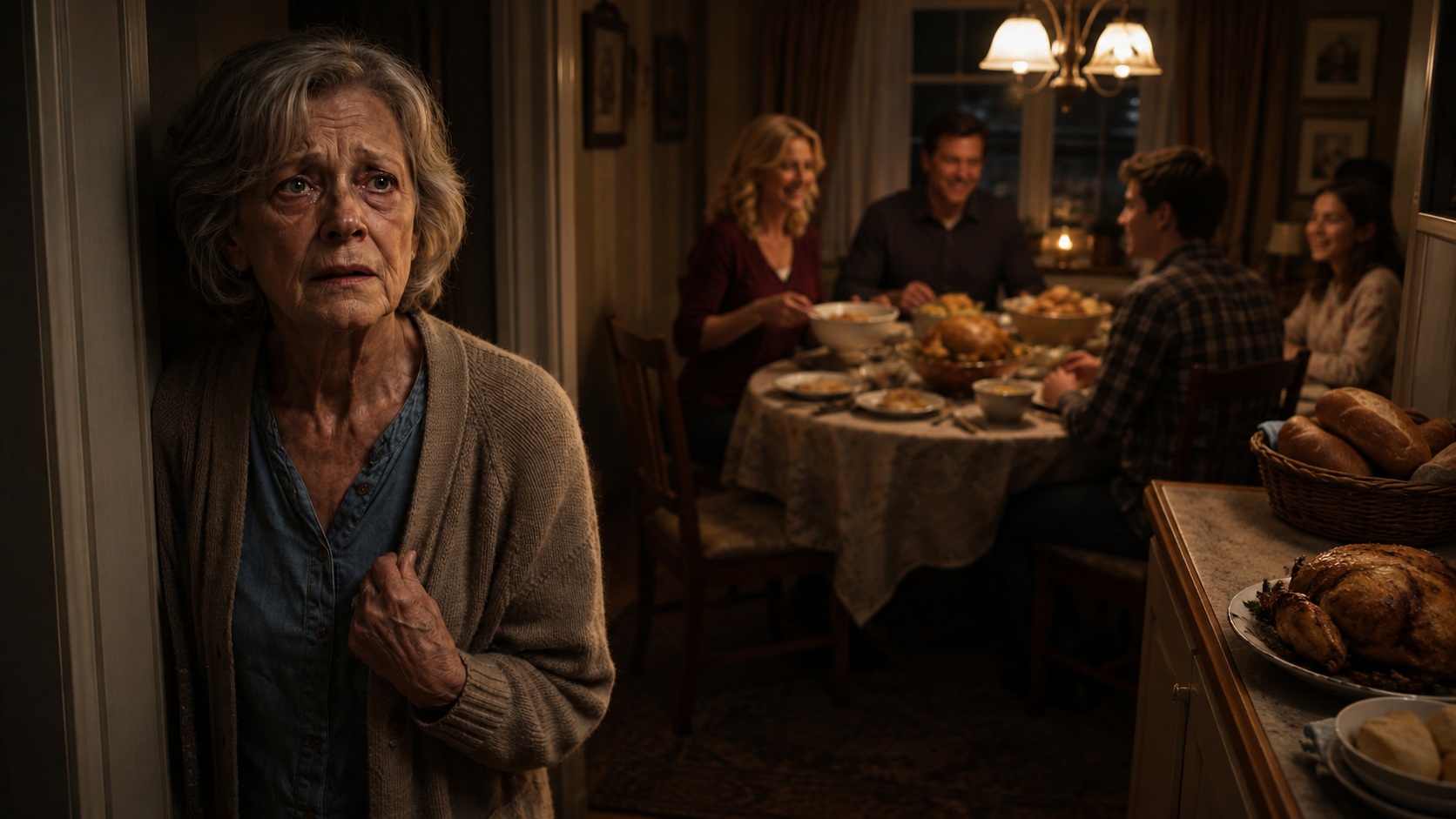
I spent the entire day cooking Christmas dinner, only to have my mother-in-law make me eat standing in the kitchen. “Servants don’t sit with family,” she sneered. When I tried to take a seat, she shoved me so hard I started miscarrying.
I never told my in-laws who my father was because I wanted one thing my husband promised me when we got married: a normal life built on love, not influence. My name is Claire Bennett. I taught tenth grade English at a public high school in Columbus. My husband, Ryan, was an ambitious attorney downtown. His mother, Patricia, made it clear from day one that I wasn’t the woman she’d pictured for her son. Too quiet, too independent, too unimpressed by status.
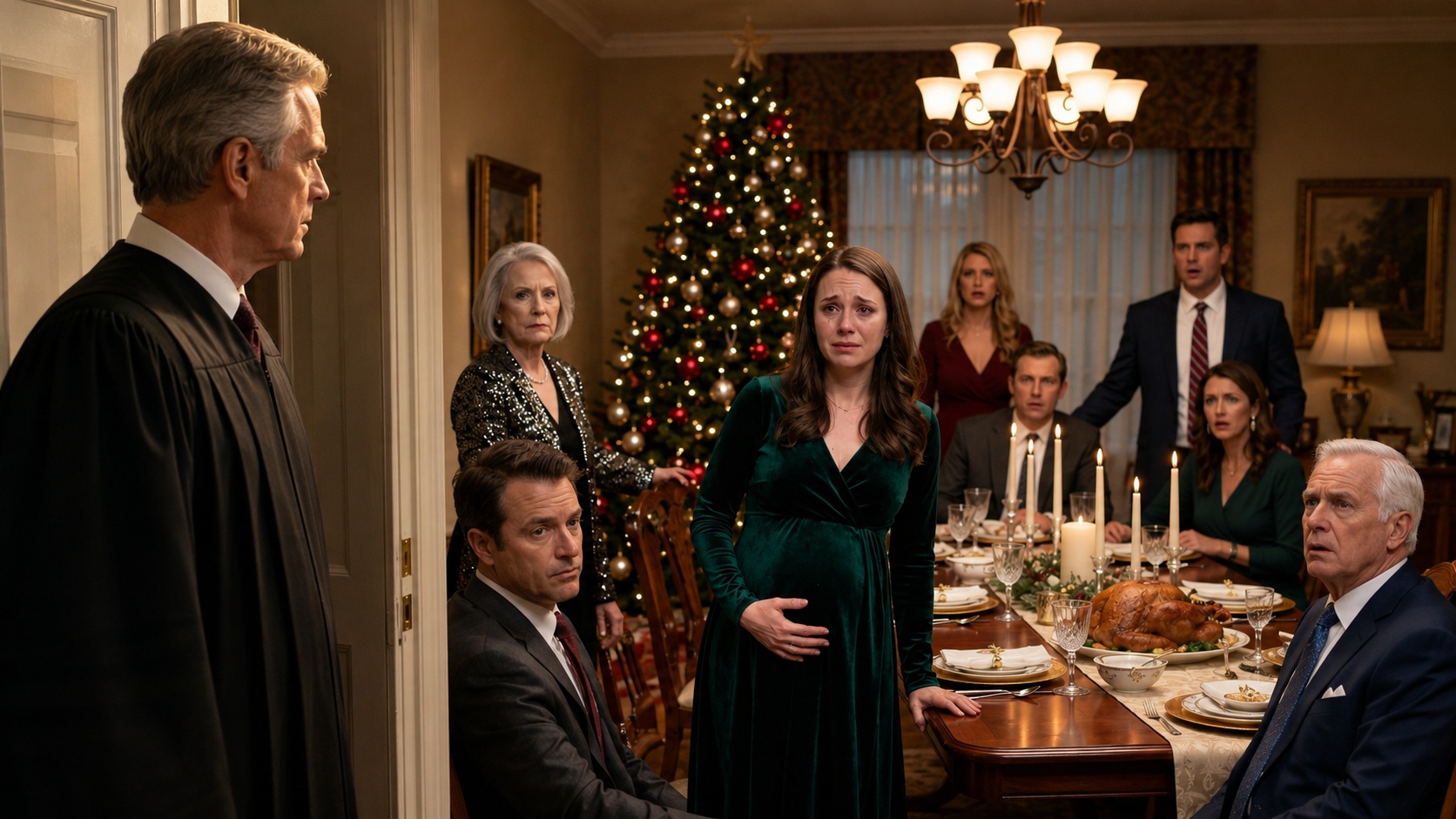
That Christmas, Ryan insisted we host dinner because “Mom likes tradition.” I spent the entire day preparing everything myself, the turkey, the casserole, homemade rolls, pecan pie, even Patricia’s favorite cranberry relish, though she’d never once thanked me for it. I was nearly twelve weeks pregnant, exhausted, with a dull ache in my lower back all week. Ryan kissed my forehead before his family arrived and said, “Just get through today.”
By six o’clock, the house was full of relatives, coats everywhere, football blaring from the den. Patricia took credit for my decorations within ten minutes. I swallowed the insult and kept serving.
When everyone finally sat down, I carried out the last dish and reached for the only empty chair. Patricia looked straight at me, loud enough for the whole room to hear.
“No. You eat in the kitchen.”
The room went silent. Then she smiled, thin and ugly.
“Servants don’t sit with family.”
Heat rose to my face. I looked at Ryan, waiting for him to say something. He only stared at his plate. My hands began to shake.
“I cooked this meal,” I said carefully. “I’m sitting down.”
I pulled the chair back.
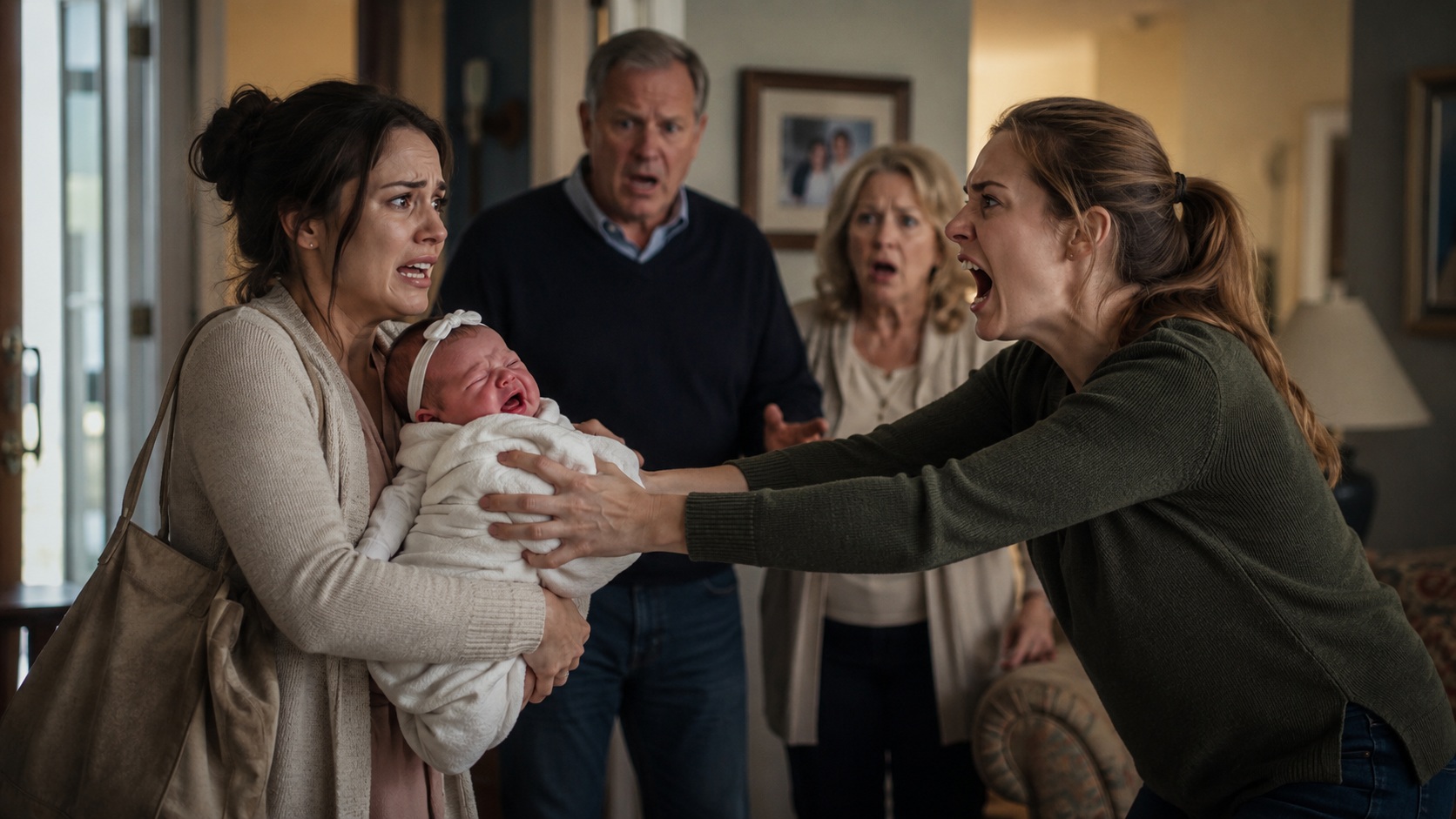
Patricia stood up so fast it scraped against the hardwood, marched over, and shoved me with both hands so hard I slammed into the corner of the kitchen island. The pain hit sharp and immediate. I grabbed the counter, then looked down and saw blood spreading across my dress.
And that was when everyone finally stood up.
Part 2: Blood on the Marble
Someone screamed. I think it was Ryan’s aunt. The room dissolved into noise, chairs scraping, a plate shattering somewhere behind me, but all of it sounded far away, muffled, like I was underwater. I slid down against the cabinet, one hand pressed to my stomach, the other gripping the edge of the counter so hard my knuckles went white.
“Claire.” Ryan was suddenly on the floor beside me, his face the color of the tablecloth. “Claire, look at me. Stay with me.”
“Call an ambulance,” I heard myself say, very calm, the way you get calm when your body has decided panic won’t help you. “Ryan. Call now.”
He fumbled for his phone. Behind him, Patricia hadn’t moved. She stood over both of us with her arms crossed, and when Ryan’s father, a quiet man named Frank who I’d always liked, tried to help me up, she said, “She’s being dramatic. It’s probably nothing.”
I looked up at her from the floor, blood soaking through my dress onto the tile, and something in me went very still and very cold.
“Nothing,” I repeated.
The paramedics arrived eleven minutes later. Eleven minutes of Patricia refusing to apologize, refusing to leave the room, telling anyone who’d listen that I’d “lost my balance” and that she’d “barely touched me.” Ryan didn’t correct her. Not once. He held my hand in the ambulance and cried, but in that house, in front of his family, he’d said nothing.
At the hospital, the doctor’s voice was gentle in the particular way doctors get when they’re about to say something that will break you. I don’t remember most of what she said. I remember the word “gone.” I remember Ryan’s hand going slack in mine, like he’d been holding onto something that had already left.
What I remember most clearly is the silence after, and the decision that formed in it, quiet and absolute. I was done protecting people who had never once protected me. I reached for my phone, scrolled to a contact I hadn’t called in months out of respect for the boundary I’d built myself, and typed a single text.
Dad. I need you.
Part 3: The Call I Never Wanted to Make
My father called back within ninety seconds. I hadn’t heard his voice shake like that since my mother’s funeral.
“Where are you. Tell me where you are right now.”
I told him. I told him everything: Patricia’s words, the shove, the blood, the eleven minutes she spent calling me dramatic while I lay on her son’s kitchen floor. I heard him go very quiet on the other end, the particular quiet of a man doing everything in his power not to lose control.
“I’m coming,” he said. “I’m coming tonight.”
Ryan sat beside my hospital bed, hollowed out, repeating “I’m sorry, I’m so sorry” like a man bailing water out of a boat that was already underwater. I let him say it. I didn’t have the strength yet to tell him that sorry, from a man who’d watched his mother shove his pregnant wife and said nothing, wasn’t going to be enough.
“Who were you talking to?” he finally asked, noticing my hands still trembling around the phone.
“My father.”
“You never talk to your father. You always said he was busy, that he traveled constantly, that…”
“He is busy,” I said. “He’s about to be very busy with your family.”
Ryan didn’t understand yet. He thought I meant a stern phone call, maybe a lawyer’s letter. He had no idea that the quiet, private man I called “Dad,” the one I’d shielded his family from for six years because I wanted to be loved for myself and not for what he represented, held one of the most powerful judicial offices in the country.
He found out at 7 a.m., when two things happened within the same hour: a car with government plates pulled up outside his parents’ house, and a hospital incident report, filed not by Patricia, but by the ER social worker who’d noted “suspicious circumstances consistent with an assault,” landed on a detective’s desk in Columbus.
My father didn’t come to make a scene. He came to sit beside my hospital bed, take my hand, and say four words that undid six years of silence.
“You should have called sooner.”
Part 4: The Chief Justice’s Daughter
Patricia found out who my father was the way she found out everything, through gossip, except this time the gossip came from a police detective standing in her foyer with a folder under his arm.
“Mrs. Bennett,” he said. “We need to ask you some questions about an incident on Christmas Eve involving your daughter-in-law, Claire Bennett, daughter of Chief Justice Bennett.”
I wasn’t there to see her face. I didn’t need to be. Ryan called me an hour later, his voice unrecognizable.
“Claire. Your father is Chief Justice Bennett? The one who… Claire, why didn’t you tell me?”
“Because I wanted you to marry me,” I said. “Not my father’s title. And for six years, I got to find out exactly how your family would have treated me if they’d known. Now you all get to live with what that answer was.”
I want to say I felt triumphant. Mostly I felt tired, and grieving, and hollow in a way no reveal could fix. My father hadn’t come to rescue me with power; he’d come as a father whose daughter had been hurt, and it was the hospital’s own report, not his name, that opened the investigation. But there was no controlling what happened once Patricia’s name and mine sat in the same file. The story moved through the state bar, through Ryan’s law firm, through every relative who’d sat silent at that table, faster than any of them could manage it.
Patricia was charged with assault. Not because of who my father was, but because what she did was a crime, plainly documented, witnessed by a room full of people, one of whom had finally been willing to give a statement: Frank, Ryan’s father, the quiet man who’d tried to help me off the floor.
Ryan came to see me at my parents’ house, where I was staying to heal. He looked like he’d aged five years in five days.
“I should have stood up for you at that table,” he said. “I should have stood up for you every day before that, too. I kept telling myself I’d fix it eventually. I’m not asking you to forgive me. I don’t think I’ve earned the right to ask you for anything.”
I believed he meant it. I also knew that meaning it, after everything, wasn’t the same as having earned it back.
Part 5: A Verdict of Her Own
The case against Patricia never needed my father’s office to move forward. The evidence did that on its own. But her trial became something else entirely in the local papers: a lesson, retold in every headline, about what happens when contempt curdles into violence, and who ends up paying for it.
I testified. Not as the Chief Justice’s daughter, but as Claire Bennett, English teacher, who had lost a pregnancy on her mother-in-law’s kitchen floor while being told she was being dramatic. That was the truth that mattered, and it was the truth the jury heard.
Patricia was convicted of assault. She received probation and a mandated program, not the years some strangers online had wanted for her. Real justice is rarely as tidy as revenge fantasies want it to be, and I’d stopped needing it to be. What I needed was simpler: for the truth to be said out loud, in a room, where no one could call me dramatic again.
Ryan and I are separated. Not out of spite, but because I finally asked myself the question I’d avoided for six years: would I have married a man who stayed silent while his mother hurt me, if I hadn’t already been so deep in love with the life I’d built? I don’t fully know the answer. I know I couldn’t build another six years on top of that silence to find out.
I still teach tenth grade English in Columbus. My father calls every Sunday now, not out of guilt, just because we’d both quietly missed six years of Sundays. I’m not sorry I kept his name out of my marriage. I wanted to be loved without it. I found out, in the worst possible way, exactly how much I already was, and by whom.
Some people only learn who you are when it’s too late to matter to you anymore. That, more than any title, turned out to be the only verdict I needed.
THE END